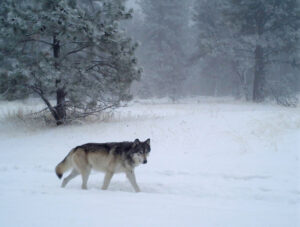
OHA has again asked the Oregon Fish and Wildlife Commission to direct ODFW staff to initiate a wolf management pilot project using controlled take along with a monitoring program within the Wallowa District of the Northeast Region.
“Wolves have prospered in Oregon, and this past year’s 13% minimum population growth is a strong indicator,” said Jim Akenson, OHA State Board member. “It is time to normalize the species and consider other wildlife and social values that wolves are negatively influencing, such as ranching and elk hunting.”
The Wallowa County Wolf Work Group – in which OHA participates – had an opportunity to address the Commission at its April meeting in Lincoln City to inform them on the current impacts of wolves and the need for a pilot project involving controlled hunting of wolves in a specific area.
“We had hoped for the Commission to direct ODFW staff to pursue that,” Akenson said. “We may not have accomplished that objective, but feedback indicates that our message on management need was both clear and urgent. OHA’s request connects to the criteria for applied controlled take in the Oregon Wolf Conservation and Management Plan and meets the conditions of chronic livestock depredation and elk populations not meeting management objectives.”
All six wildlife management units in the Wallowa District are below elk management objectives, according to 2026 ODFW data. Elk populations in the Wallowa District range from a low of 31% of management objective in the Wenaha Unit to 91% in the Chesnimnus Unit. The three units where livestock depredation is current and persistent are Minam, Chesnimnus, and Sled Springs, which are at 55%, 91%, and 58% of management objective, respectively.
Another key indicator of elk population health is cow-calf ratios, which currently occur at 17 calves per 100 cows for the Minam, Chesnimnus, and Sled Springs units, respectively. These are not adequate ratios, and they are well below a targeted minimum of 30 per 100 desirable to support a healthy elk population.
OHA will continue working to ensure we better understand the impacts of wolf predation on ungulates and that intensive management of wolves occurs for the benefit of deer, elk and moose in Oregon.
