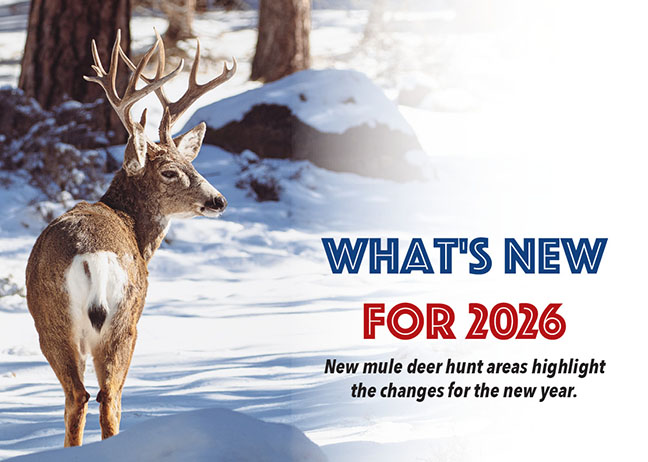
 The Oregon Fish and Wildlife Commission signed off on the 2026 big game hunting seasons and regulations proposed by ODFW staff at its Sept. 12 meeting in Ontario. Those proposed regulations contained the usual mix of changes, which for next year include tag number adjustments, new fair chase rules and a controlled hunt tag application fee increase. But the big one, to put it mildly, is a change in mule deer hunt boundaries based on years of field research that will fundamentally change eastern Oregon mule deer hunt areas and substantially improve the accuracy in collecting deer herd data for management and conservation purposes.
Here’s a look at the major changes for 2026.
Mule Deer
Replacing wildlife management units with deer hunt areas for determining hunt boundaries is the major news for next year’s mule deer seasons and beyond, and marks a fundamental change in how ODFW manages mule deer populations and hunting harvest.
Over the past several years, ODFW conducted extensive mule deer research that included capturing and collaring more than 1,400 deer to track their seasonal movements. In the process, biologists identified 22 distinct herd ranges for mule deer in eastern Oregon. Identifying those ranges, defined as areas that deer herds use over the course of a year, allowed for developing significantly improved population models that integrate key variables, such as buck and doe ratios comprising each herd, along with more accurate abundance and harvest data. An important factor is that to more accurately evaluate mule deer herds, it is critical to study each herd within its year-round range, rather than within the somewhat arbitrary boundaries of wildlife management units.
This shift to providing hunts based on management unit boundaries to deer hunt areas that take into account seasonal herd movements will allow ODFW to better monitor deer herd size, competition and health, and place hunters in areas where greater numbers of deer are more likely to be present during hunting seasons.
Some deer hunt areas will encompass a deer herd’s entire range, while others have been split into smaller hunt areas based on such factors as where they move across the landscape, different types of habitat and land uses within their ranges, fire history of those areas and other variables that impact the herds. The result is that quite a few herd ranges have been divided into multiple hunt areas.
Mule Deer Tags and Hunts
This new paradigm required ODFW biologists to essentially delete most previous hunts and replace them with new hunts to account for the new herd movement-based hunt boundaries. The final results for 2026 eastern Oregon mule deer hunts provide similar offerings as in the past – although there may be some major differences in individual hunt areas – but will provide for fewer tags due to the continuing low deer population levels. Overall, hunters will have 9 percent fewer mule deer tags for 100-series buck deer hunts throughout eastern Oregon, and an 8-percent reduction in 600-series antlerless deer tags statewide.
Because of these big changes in mule deer hunts, it will be extremely important for hunters to review hunts offered and their adjusted boundaries when deciding which hunts to apply for to ensure that they will end up hunting in their desired area. More information can found on the ODFW website at: https://myodfw.com/articles/eastern-oregon-deer-hunts
Mule Deer Population
Having developed improved techniques for estimating mule deer numbers, ODFW now has more accurate population data. The 2025 mule deer population is now estimated to be about 171,700 throughout their eastern Oregon range. This is an increase of less than one-tenth of a percent from 2024, and an increase of 1 percent from 2023. The bottom line, although there has been some small improvement, is that Oregon’s mule deer population is still very much at-risk. Of the 22 identified herds, 14 are classified as of “extreme concern” and 5 at “very high concern.”
Black-tailed Deer
No changes are in store for black-tailed deer hunts for 2026. While there is no population estimate or specific management objectives for black-tailed deer, recent, more accurate monitoring methods indicate the population is no longer declining.
Elk
Changes for 2026 elk seasons are primarily some reductions in tag numbers, including deleting five cow hunts and a reduction of tags for the NW Santiam cow hunt, Hunt 216, from 50 to 22 because of concerns about population numbers and a decrease in elk-human conflicts. Deleted western Oregon antlerless elk hunts include: Pengra, Mosby, Santiam Late Bow, Mckenzie Late Bow and North Indigo Late Bow.
Two eastern Oregon hunts (North Wagontire and Umatilla Youth) are deleted, but three new hunts (Ukiah Youth, Walla Walla Youth, The Dalles Watershed Bow) have been added.
Overall, there will be a 1 percent decrease in available elk tags for 2026.
Oregon’s eastern Oregon Rocky Mountain elk population continues to do very well. Of 35 eastern Oregon units with elk population data available, 24 have elk numbers at or near objectives, and 14 units have numbers of more than 110 percent above objective. The current Rocky Mountain elk population is estimated at 70,600.
Western Oregon elk continue to struggle. Only six of 19 units are near or above management objectives. At an estimated 52,507 animals, Roosevelt elk are only at 74 percent of the 70,850 objective.
Pronghorn
The only change for the 2026 pronghorn season is an additional 12 tags for a total of 2,059 in 52 hunts.
Oregon’s pronghorn population remains stable at 16,000 to 19,000.
Bighorn Sheep
A total of 136 bighorn sheep tags will be offered in 2026 – 81 California rams, 50 California ewes and 5 Rocky Mountain rams in 27 California bighorn hunts and three Rocky Mountain bighorn hunts. Six ram tags and three ewe tags will be available to non-resident hunters.
The tag available for the 556 Wenaha Rocky Mountain bighorn hunt is rotated between Oregon, Washington and the Confederated Tribes of the Umatilla Indian Reservation each year. Oregon was allocated this hunt in 2025, so will not offer it this year.
Oregon’s California bighorn sheep population is estimated at 4,000 to 4,200 in 32 herds. Rocky Mountain bighorn sheep numbers are 800 to 1,000 animals in 11 herds.
Rocky Mountain Goats
Hunters can apply for 21 Rocky Mountain goat tags offered in 12 hunts, with two tags allocated for non-resident hunters.
Oregon’s Rocky Mountain goat population has been stable or increasing in recent years with a current population estimate of 1,100 to 1,300 animals.
Bear and Cougar
For the 2026 controlled spring bear season, ODFW will offer 11,067 tags in 19 hunts, which is 70 more tags than were offered last season. These additional tags are for the 731A South Central Hunt (605 tags) and 754A Mt. Emily-Walla Walla hunt (242 tags). Both of these hunt areas have strong bear numbers that will not be adversely affected by increased harvest. There are no changes for fall bear season.
Oregon has a robust black bear population of about 43,000 statewide.
Cougar hunting regulations remain unchanged from 2025. The cougar population is estimated at 7,060 animals.
Tag Application Fees
Controlled hunt application fees will increase by $2, raising the cost to $10. Application fees will increase by another $1 in 2028 and again by $1 in 2030. Application deadlines remain the same.
Fair Chase
The Commission added language clarifying regulations that prohibit the use of thermal imaging devices for hunting in Oregon. The previous rule stated that: “It is unlawful to: Hunt, locate, or scout for the purpose of hunting any wildlife with infrared or other night vision sight or equipment except trail cameras.”
Expanded language includes clarification that it is unlawful “to hunt, locate, or scout, for the purpose of hunting any wildlife with infrared, including thermal, or any other “night vision” sight or equipment except trail cameras.”
This prohibition includes any thermal device that is attached to or incorporated into a scope or firearm while hunting – even if the thermal device is turned off.
In recent years, Oregon State Police have received increasing reports of poachers using thermal devices to locate wildlife at night. In December 2024, OSP arrested 13 individuals in Clackamas County for allegedly poaching deer, elk and other big game animals. Included in the bust was the discovery and confiscation of 14 thermal imaging devices.
In addition, hunting within 500 feet of the mouth of designated wildlife crossings on US Highways 20 and 97 is now prohibited. This new rule is modeled after current trapping regulations that make it illegal to set traps within 500 feet of the mouth of designated wildlife crossing structures. This new rule was added in response to public input ODFW received during the public comment period while developing the 2026 Big Game Regulations.
See more about regulations on techno-logy and even AI cautions on Page 56.
 Loading ...